Animal Saga Guide: Why Matching Tiles Will Not Connect and How to Clear More of the Board
Learn why identical Animal Saga tiles may not connect, how to open routes, and when to use hints or shuffles in this detailed browser puzzle guide.
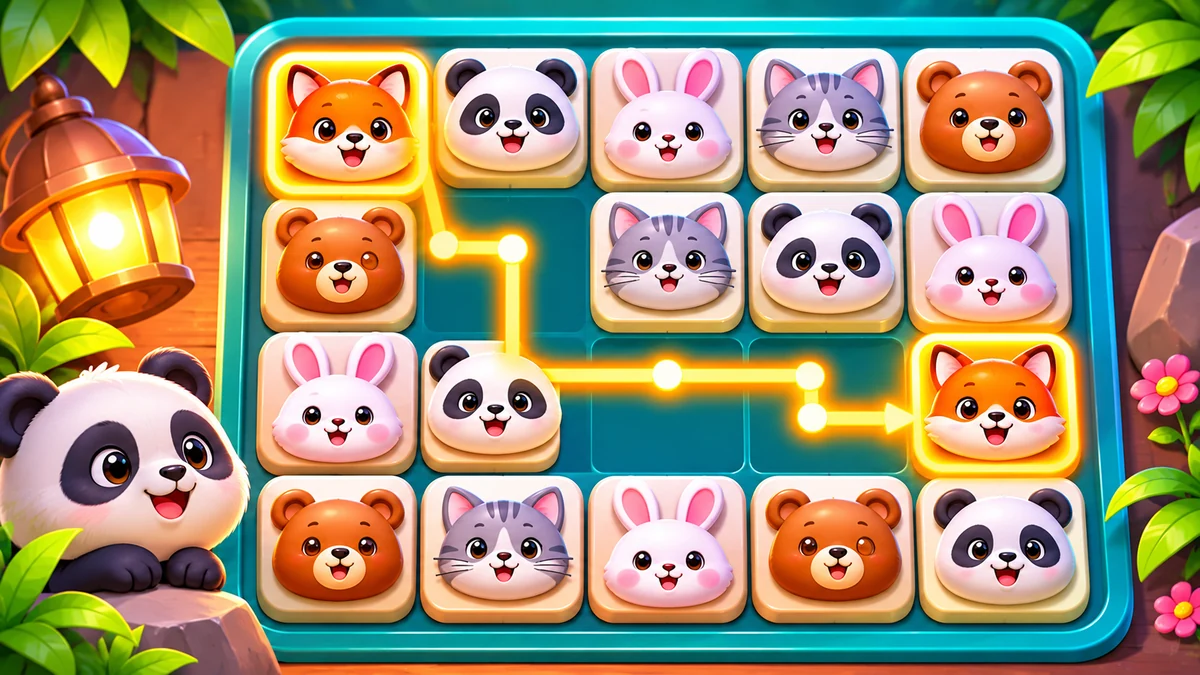
Table of Contents
- First, understand what makes a pair playable
- How to play Animal Saga step by step
- A worked example: the foxes behind a wall of tiles
- Animal Saga tile path rules explained without guesswork
- Find the most useful pair, not just the nearest pair
- When to use hint in Animal Saga
- When to shuffle Animal Saga tiles
- A reliable board-clearing strategy for beginners
- The blocked-pair diagnostic
- Why corners and edges deserve attention
- Three short practice sessions that build real skill
- Animal tile matching is not the same as ordinary memory matching
- Playing on a laptop, desktop, or phone
- Common mistakes worth avoiding
- Frequently asked questions
- Why will two identical animals not connect?
- Is Animal Saga a matching game or a path puzzle?
- Does a hint solve the whole board?
- What does shuffle do for strategy?
- Is there a universal two-bend rule?
- Can I play without downloading an app?
- Should I clear edge pairs first?
- Final takeaway: solve the route, not just the picture
Two animal tiles can look exactly alike and still refuse to disappear. That is the moment Animal Saga stops feeling like a simple picture-matching exercise and becomes a puzzle about routes. You have found a pair of foxes, but another tile sits across the obvious connection. Is there a path around it? Would removing a nearby pair create an opening? Should you ask for a hint, or is a shuffle the better choice?
Those are the decisions worth learning. In Animal Saga on RobixGame, the objective is to connect matching animal tiles in pairs and clear the board. The game page makes an important distinction: matching pictures alone are insufficient when the connection does not satisfy the board's path rules. It also identifies hint and shuffle as available ways to move forward. This guide explains how to reason about those constraints without pretending that every animal-connect puzzle follows identical rules.
First, understand what makes a pair playable
A pair has two requirements. The pictures must match, and the game must accept a route between them. You can satisfy the first requirement immediately and still fail the second. That is why the animal saga pairs not connecting fix is not necessarily to click harder or faster. It is to inspect the space between the tiles and find a connection the board permits.
Imagine two identical pandas separated by three other animals in the same row. There is no straight line connecting them through those occupied squares. Depending on the board's connection rules, a route around an empty corridor might work. If it does not, the useful question becomes which other pair you can remove to create such a corridor. Start by treating free space as a resource instead of looking only at matching faces.
The exact permitted route shapes, the maximum number of bends, and whether paths can travel outside a board edge must be confirmed in the active game. They should not be guessed from another title that looks similar. When you see a pair rejected, the behavior itself tells you that your attempted route was not legal in that position.
How to play Animal Saga step by step
You do not need to memorize a complex strategy before your first round. A repeatable observation routine is more useful:
- Open the Animal Saga game page and choose Start Game.
- Identify the kinds of animal faces on the board; note pairs near open spaces.
- Choose two identical animals that appear to have a possible connection.
- If the game accepts the pair, observe which tiles disappear and what new space opens.
- Scan the newly exposed area rather than immediately repeating a selection elsewhere.
- If a matching pair is rejected, examine possible obstructions and test a different accessible pair.
- Use the game's hint or shuffle controls when your normal inspection is no longer productive.
- Continue until the board is cleared according to the game's own win condition.
This is the practical foundation for how to connect matching animals in animal saga: matching is necessary, but a valid path is what makes the move useful. The current control method should always be checked on the game screen, especially when moving between a mouse and a touchscreen.
A worked example: the foxes behind a wall of tiles
Consider a hypothetical five-row board. Two fox tiles sit near the middle, but a strip of unrelated animals occupies the squares between them. A pair of cats at the edge can be connected immediately. Removing those cats leaves an empty passage that reaches one of the foxes. You then notice a second accessible pair near the passage. Clearing that pair extends the opening and may give the foxes a valid route.
Notice what made the first cat move valuable. It was not simply an easy match. Its removal changed the geometry of the board. You can use that principle in many layouts: favor a move that improves access to several trapped pairs over one that clears two isolated tiles but leaves the central congestion untouched.
This illustration is not a promise of an exact level layout. It is a small planning exercise that teaches you to identify cause and effect. After every successful pair, ask what corridor was created and which previously blocked animal might now be reachable.
Animal Saga tile path rules explained without guesswork
Different tile-connection games may allow direct lines, paths with limited turns, or routes along the exterior of the layout. Animal Saga's public game description confirms that connections must satisfy its path rules, but it does not publish a specific bend count. An accurate guide therefore begins with what can be observed rather than inventing a universal two-turn requirement.
When testing the animal saga tile path rules explained in your own session, watch three things. First, do open spaces between identical tiles matter? Second, can a valid path bend around occupied squares? Third, does removing an edge pair change access to animals deeper in the grid? A couple of deliberate tests will tell you more about your version than a copied rule from a different game.
Think in terms of a route from tile A to tile B. If a wall of occupied cells blocks every eligible connection, the pair cannot leave yet. You need another match to open the necessary passage. This makes Animal Saga a sequence puzzle: each removal changes the map for later removals.
Find the most useful pair, not just the nearest pair
An obvious match on the outer edge is tempting, but its value depends on what comes afterward. Before tapping, compare at least two candidates. One pair might be easy but leave a tiny isolated gap. Another might open a longer corridor toward several trapped animals. If the second pair is legal, it may be the stronger move.
One simple scoring method is to judge a move by three questions: Does it clear two tiles? Does it expose a new route? Does it help reach a tightly blocked group? You are not calculating an official in-game score; you are using a decision checklist. It keeps your attention on progress rather than on the pleasant animation of removing an easy pair.
Look for pairs near junctions where multiple empty paths could meet. These locations often offer more options afterward. If a pair appears deep inside a crowded region, note which neighboring animals need to move first and work outward from that dependency.
When to use hint in Animal Saga
The best time to use a hint is not necessarily the first moment you feel uncertain. First perform one organized scan. Check the edges, then the larger empty corridors, then the crowded middle. Compare the exact animal images instead of relying on a quick impression of color. If no legal pair is apparent after that search, a hint can help you resume progress.
The search phrase when to use hint in animal saga is really about learning from assistance. When the hint identifies a move, pause before acting. Ask yourself why the move is valid and what opening it might create. The benefit is greater if you can recognize a similar opportunity during the next round.
The website describes hint as an available control. It does not specify unlimited uses, a recharge system, or any penalty for using it. Read the active interface before assuming a particular cost. There is no need to invent a limitation just to make the advice sound more dramatic.
When to shuffle Animal Saga tiles
A shuffle is a different kind of intervention. Rather than pointing toward a particular pair, it changes the arrangement in a way that may make new connections possible. That can be useful when the visible position is congested or your repeated scans are revealing no path.
If you are deciding when to shuffle animal saga tiles, use this sequence. Reassess open lanes after the last successful clear. Look for a pair you might have missed. Consider whether a legal move is available but strategically awkward. Only then check the shuffle option. After a shuffle, forget your old pair locations and scan the new board from scratch.
Do not claim that shuffling always guarantees a solution, preserves every previous advantage, or has no restrictions. Those details depend on the implementation. The reliable lesson is that a changed board requires a changed plan. You cannot continue using a route mapped before the rearrangement.
A reliable board-clearing strategy for beginners
A useful animal saga beginner walkthrough should teach a system, not just a list of random taps. Start by identifying one accessible region, preferably near open paths. Remove a pair whose absence makes neighboring tiles easier to connect. Then inspect the newly uncovered routes. If a blocked pair becomes available, clear it before forgetting the opening you worked to create.
Many players make the mistake of scanning the entire board anew after every move. That can be tiring. Instead, concentrate briefly on the neighborhood of the removed pair because the local geometry has changed there. Then perform a wider scan if nothing useful appears. This alternation between a local check and a global check is faster than randomly jumping around the grid.
Also learn to distinguish difficulty from impossibility. A rejected pair does not show the puzzle is broken. It shows that the current route is not accepted. A series of rejected guesses, however, is a sign to change your method: review empties, find different identical animals, or try a help control.
The blocked-pair diagnostic
For players searching animal saga game tips for blocked pairs, use this six-question diagnosis:
- Are the two animals truly identical, including small details?
- Is an occupied tile sitting along the apparent route?
- Is there a nearby empty corridor that might connect them?
- Can another legal pair be removed to open that corridor?
- Did the last removal create a new route you have not checked?
- Would a hint or shuffle provide information after an unsuccessful systematic scan?
This checklist can help identify why a move failed without requiring a screenshot or a particular level number. The answers also train you to notice the relationship between identical art and the path network around it.
Why corners and edges deserve attention
Edges are often useful because they define the boundary of the playing area and can sit beside longer open runs. But edge tiles are not automatically valid: a path can still be blocked, and some puzzle implementations treat paths beyond the boundary differently. Avoid blanket rules such as “every outer pair connects.” Check what the current game actually allows.
Corners are good places to start a scan because fewer neighboring squares can hide matching candidates. Look at the nearest matching image, evaluate whether the route is open, and consider whether clearing it would connect an edge corridor to the interior. A small opening in a corner can sometimes trigger a chain of more flexible moves.
If your first several removals are all at the edges and the middle remains packed, consider changing priorities. The strongest animal saga board clearing strategy balances easy pairs with moves that reach heavily constrained areas.
Three short practice sessions that build real skill
In the first session, ignore speed and name the reason for each successful connection. Say to yourself: “same animal, open route” or “same animal, blocked route.” You are learning the rule rather than chasing a result.
In the second session, try to choose pairs according to the space they create. After each removal, identify one possible follow-up. You will begin to see the board as a sequence of decisions rather than a static collection of pictures.
In the third session, use help controls deliberately. If you require a hint, study the move. If you shuffle, scan the board afresh. The goal is to become less dependent on repeated guessing, not to prove that assistance is somehow wrong.
Animal tile matching is not the same as ordinary memory matching
In a memory-matching game, tiles may be hidden and you need to remember their positions. In Animal Saga the visible animals are not the whole challenge: route legality matters. If you approach it only as a memory test, you may find matching faces quickly but still struggle to remove them.
The search free animal tile connect game browser covers many titles that share a broad visual style but differ in routing and scoring. Animal Saga is one specific game with its own in-game rules. If you switch to another connect puzzle, read the instructions again before transferring your assumptions about allowable paths or special tools.
Playing on a laptop, desktop, or phone
Animal Saga is presented on a browser game page. Browser access does not automatically guarantee identical controls on every device. On a laptop, check whether selecting two tiles uses clicks. On a phone, confirm that tiles are large enough to tap accurately and that no essential part of the grid is hidden by a toolbar.
If selections appear unresponsive, begin with the simplest checks: make sure the game started, verify that you selected matching animals, and inspect the path. Do not immediately change browser settings or repeatedly refresh, since a refresh may reset an ongoing session. The search play animal saga online without installation is about convenient access, not a promise of offline operation.
The RobixGame home page offers other casual challenges, but Animal Saga's dedicated page remains the best place to check this game's current controls and purpose.
Common mistakes worth avoiding
The first mistake is selecting matching images without considering the path. The second is spending too long on one blocked pair while legal alternatives remain. The third is using help without learning from it. The fourth is continuing to follow an old plan after a shuffle changes the arrangement.
A subtler error is overvaluing visual neatness. Removing two animals from a tidy corner can feel productive, but it may do little to release a blocked middle region. Think about accessibility rather than aesthetics. Clearing a route that helps three other pairs is often more useful than making the board look symmetrical.
Finally, avoid copying a solution from a screenshot that is not your current puzzle. Different arrangements can contain the same animals but require a different sequence. Treat examples as reasoning practice, not guaranteed walkthroughs.
Frequently asked questions
Why will two identical animals not connect?
They may not have a legal path between them under the game's connection rules. Look for blocked spaces and another pair that can create an opening.
Is Animal Saga a matching game or a path puzzle?
It combines both ideas. You identify matching animal tiles, but the permitted connection route also matters.
Does a hint solve the whole board?
The game page confirms a hint control but does not describe it as an automatic complete solution. Use the active game's guidance to understand what it provides.
What does shuffle do for strategy?
It gives you a changed arrangement to evaluate. Recheck all possible pairs instead of continuing to follow a plan designed for the previous layout.
Is there a universal two-bend rule?
Do not assume one. Different tile-connect titles use different route restrictions. Follow the version actually running on the game page.
Can I play without downloading an app?
The game is offered through a web page. It may still need an internet connection to load and is not guaranteed to be playable while offline.
Should I clear edge pairs first?
They are worth examining, but a move is only useful when it is legal and improves the remaining position. A middle pair that opens several paths may be stronger.
Final takeaway: solve the route, not just the picture
Animal Saga becomes more satisfying when you learn to see paths rather than only matching faces. Select a legal pair, notice the corridor it opens, and use that corridor to reach previously blocked animals. When you are stuck, inspect methodically before reaching for hint or shuffle. The result is a clearer way to play, whether you are new to the genre or have been guessing at pairs for a while.
Ready to put those ideas into practice? Play Animal Saga on RobixGame and try completing a round while deliberately identifying what each removed pair makes possible next.