Cube 3D for Beginners: Turn the Right Layers and Match All Six Faces
Understand camera rotation, layer turns, centers, edges and corners in Cube 3D. Learn reversible moves and plan a standard 3×3 solve step by step.
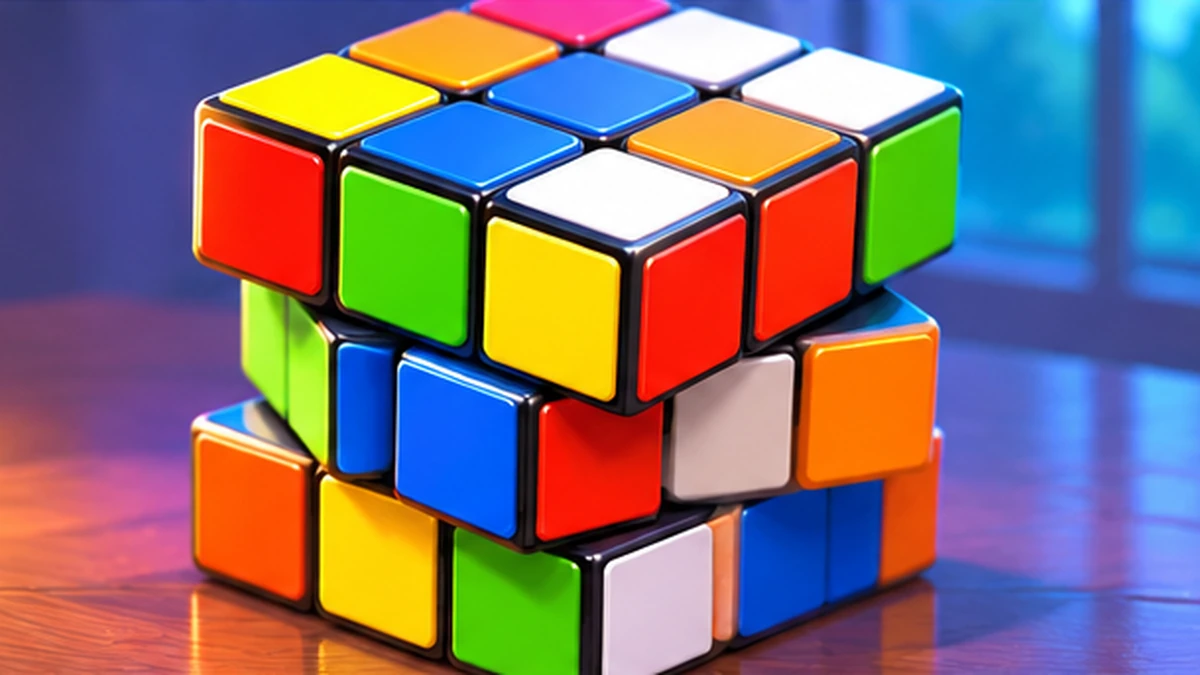
Table of Contents
- Find a useful starting configuration
- Camera movement and layer turns are not interchangeable
- Understand centers, edges and corners
- Why a single-colored face is not a complete solution
- A reversible move experiment
- Basic notation for learning a standard solving method
- Plan a full solve by layers
- Start with the cross
- Complete the first-layer corners
- Work on the middle edges
- Finish the last layer
- A worked decision: two possible edge locations
- What to do if the cube seems impossible
- Use the timer without letting it dictate the solve
- Browser setup for desktop and touch play
- Cube solving questions
- Does changing my view count as a solving move?
- Can I choose a smaller cube?
- Why is my first face solved but the rest is not?
- Is there a single sequence that solves any scramble?
- How do I play Cube 3D without app installation?
- What should I practice if I keep making unintended turns?
- Make the next move understandable
The first time you turn a scrambled color cube, a tile you were carefully moving toward the front can disappear around a corner. A few moves later, the front might look more organized while the side is now a mess. This is why Cube 3D is such a different puzzle from a flat matching game. You are working with an object whose parts move together. Success depends on understanding the relationships between those parts, not just making the visible colors look attractive.
This is a practical introduction to how to play Cube 3D online on RobixGame. It covers the difference between rotating the camera and turning a layer, the meaning of a completed face, how to track pieces, and how to approach an unfamiliar scramble. It also introduces the standard layer-by-layer approach for a conventional three-by-three cube. You do not need to chase a fast solving time on your first visit.
Find a useful starting configuration
Open Cube 3D on RobixGame and start the player. The game description identifies an interactive color cube with adjustable size and scramble difficulty, along with a timer. Choose a configuration before beginning the attempt. If you have not solved this type of puzzle before, use an approachable size and difficulty rather than immediately choosing the most complicated arrangement available.
Why does this matter? A small scramble is a manageable experiment. If you can see how one or two layer turns affect the object, you can begin to predict those movements. A heavily scrambled cube presents many unfamiliar relationships at once. You may spend more time recognizing the pieces than actually learning how to move them.
For conventional cube solving, a standard 3×3 configuration offers fixed center references, two-color edge pieces and three-color corner pieces. Other cube sizes introduce different problems. A 2×2 has only corner pieces, for example, while larger cubes may require grouping centers and edges. The following center-based explanations apply to a conventional 3×3; check the size you have selected rather than assuming the same technique works unchanged on every version.
Camera movement and layer turns are not interchangeable
The most important Cube 3D camera and layer controls distinction is what actually changes. Rotating your view reveals another side of the same arrangement. Turning a layer changes which pieces occupy which positions. Both actions make the screen look different, but only the second changes the puzzle state.
Imagine that a blue-and-red edge is located at the top front of a standard cube. If you orbit the camera, it is still between the same physical faces even though it may appear on the other side of the screen. If you turn the upper layer, the piece itself travels to another edge position. You need to know which action you performed before interpreting the result.
Practice a short input using the game's displayed controls. Watch whether the whole cube changes its viewing angle or a section turns relative to the rest. If the wrong action happens, restore a familiar view and make a smaller, clearer input. Avoid a rapid series of drags until you can consistently select the intended action. This small exercise helps prevent one of the most frustrating beginner errors: thinking that a solving sequence failed when the view was actually changed instead of a layer.
Understand centers, edges and corners
A standard three-by-three cube has different kinds of pieces. Each center displays one color and acts as a reference for its face. An edge displays two colors and belongs between those two center colors. A corner displays three colors and belongs at the intersection of three corresponding faces. The individual colored squares are sometimes called stickers or facelets. They are not independent pieces that you can move individually.
Suppose you see a red-blue edge. Its correct destination is the edge between the red and blue centers, regardless of which side happens to face you. A red-blue-yellow corner must occupy the intersection of those three centers. Getting the red sticker onto the red face is only part of that piece's job. The other colors must match their faces too.
This is the heart of a useful Cube 3D edge and corner guide. When you track complete pieces instead of individual facelets, you can tell whether something is correctly positioned, incorrectly oriented or simply located elsewhere. Those three situations require different decisions. You should not try to move an already correctly positioned piece to a completely different location just because its visible sticker is facing the wrong direction.
Why a single-colored face is not a complete solution
A common early achievement is creating a solid white face. It looks excellent from above, but a closer inspection may show red, green and orange stickers scattered along the neighboring rows. The top face has the desired color, yet some pieces are in the wrong positions relative to the adjacent centers.
To understand how to align cube side colors, inspect the band of stickers immediately below the completed face. On a correctly solved first layer of a conventional cube, the adjacent stickers align with their own center colors. A white-red edge should have white on the white face and red toward the red center. A white-red-blue corner must agree with all three sides. A uniform top with mismatched neighboring rows is not the same thing as a solved layer.
You can practice this check even before learning a full method. After making any promising arrangement, rotate the view without changing the layers and inspect its neighbors. If they disagree with the centers, identify one example of a misplaced piece. That observation is more useful than adding several random turns to try to fix the appearance of the face.
A reversible move experiment
Consider a conventional cube that is currently solved, or another arrangement you can easily recognize. Hold a consistent front view. Turn the upper layer by a quarter turn, then turn the same layer back in the opposite direction. The original arrangement should return. If it does not, check whether you turned a different layer, changed the viewing angle or made a different-sized rotation.
Now try two moves, perhaps an upper-layer turn followed by a right-layer turn. To reverse them, undo the right-layer turn first and then undo the upper-layer turn. Reversing the order matters. The second action was applied to the result of the first, so restoring the earlier arrangement generally requires undoing the actions in reverse order.
This exercise explains an important idea for Cube 3D reverse scramble practice. A short known scramble is not a mysterious puzzle: you can undo the sequence if you remember exactly what you did. A longer unknown scramble needs a more systematic solving method. Start with reversible experiments to learn the mechanics and move to a repeatable method when you are comfortable with the controls.
Basic notation for learning a standard solving method
If you read a guide to a conventional cube, you will often encounter letters that describe faces. The following names assume that you are holding a fixed orientation. R means right, L means left, U means upper, D means down, F means front and B means back. A letter by itself commonly means a quarter turn clockwise when looking directly at that face. An apostrophe means a turn in the opposite direction, and the number 2 indicates a half turn.
This notation describes physical layer movements, not keyboard shortcuts. The actual browser player may use pointer or touch controls instead. Translate the intended face and direction into the available gesture. Keep the front view consistent throughout a sequence so that R continues to mean the same physical face. If you reorient the object halfway through without accounting for the new viewpoint, a memorized sequence can become the wrong sequence.
A short example is R U R' U'. From a suitable orientation on a conventional cube, this sequence moves several pieces and is frequently used as a building block in solving methods. Do not assume it solves every corner or every scramble. Its inverse is U R U' R'. Try the original sequence, inspect the change and then apply its inverse to restore the starting arrangement. This is a controlled lesson in how sequences affect the puzzle.
Plan a full solve by layers
A Cube 3D beginner layer solving approach starts by separating the overall task into smaller goals. For a conventional 3×3, one common method is to build a first-layer cross, complete its corners, position the middle-layer edges and then solve the last layer. More advanced methods may combine steps differently, but the basic stages provide a helpful way to understand progress.
Start with the cross
Choose a reference center, often white in beginner methods. Find the four edges that include its color. Bring them to the matching positions around the center and align each edge's other color with its neighboring center. You are not just making a plus sign; you are building an aligned group of pieces.
Complete the first-layer corners
Locate a corner containing the reference color. Identify its other two colors before moving it. Its destination is between the three appropriate centers. Bring it to a suitable working position and use a corner insertion sequence appropriate to its orientation. Keep the cross pieces intact or restore them as part of the intended sequence.
Work on the middle edges
With the first layer arranged, look for edges belonging between the side centers. In a traditional beginner method, you can use the unsolved layer as a working area and insert an edge into the middle layer. The direction of insertion depends on its target location. Do not apply an insertion sequence until you know which edge and slot you are dealing with.
Finish the last layer
The final layer usually needs both orientation and positioning. You may create a cross on the last face, orient its corners and arrange the remaining pieces into their proper locations. Exact algorithms depend on the pattern and chosen method. Consult a complete standard solving method for the case you see instead of applying an arbitrary sequence. The game is the place to practice the moves, not a reason to assume every pattern has the same solution.
A worked decision: two possible edge locations
Picture a standard cube with a white-red edge currently in the unsolved upper layer and a white-green edge already correctly positioned in the first-layer cross. You want to move the white-red edge toward the red center. Turning an entire side without checking the white-green edge could disturb progress you have already made.
First locate both pieces. Second, identify a move or setup that puts the target edge into a useful position. Third, consider whether the solved edge will move. If the intended sequence temporarily displaces it, make sure the continuation restores it. A good plan can include temporary disturbance, but it should not treat the solved piece as disposable.
This hypothetical example does not give the precise turns because those depend on the exact positions and orientations. It demonstrates how to preserve solved cube pieces while pursuing a new goal. Before choosing a familiar sequence, identify whether the current state actually matches the sequence's intended starting case.
What to do if the cube seems impossible
A normal legal scramble of a conventional cube is solvable. However, a beginner may reach a position that looks impossible because some colors are hidden, a piece is misunderstood, or the wrong sequence was used. Before replacing the scramble, inspect the object from multiple angles. Verify the cube size and the target centers. Then check which parts you have genuinely solved.
If a known sequence produces an unexpected result, isolate the last few actions. Did you use the same orientation throughout? Did an inverse turn actually go in the opposite direction? Did a drag move the camera instead of the intended layer? These are concrete questions that can identify an input or interpretation error without discarding an entire attempt.
Starting a new scramble is useful when you want a fresh practice problem, but it is not a repair method for the current arrangement. If you are making progress, keep the same puzzle long enough to learn what the next stage requires.
Use the timer without letting it dictate the solve
The game page describes a timer for the solving attempt. For your first few sessions, ignore the absolute time and concentrate on intentional moves. You can record how long a recognizable stage takes, such as building a correctly aligned cross, rather than comparing incomplete attempts with expert full solves.
A sensible Cube 3D scramble difficulty practice routine might involve one short session on a simple configuration, another on selecting the correct layers and a third on a specific stage of a larger solve. After the technique feels comfortable, repeat it under the same configuration to see whether your movements become smoother. Do not compare a light scramble with a much more difficult one as though the times were directly equivalent.
Speed comes partly from reducing hesitation and unnecessary adjustments. A slower accurate turn is better than a quick turn that forces several corrective moves. Memorization alone is not enough if you regularly lose the physical orientation of the cube.
Browser setup for desktop and touch play
Visitors looking for a color cube puzzle browser game can use the RobixGame page without installing a separate application. The player is listed for desktop and mobile, but verify that the gestures respond correctly on the device you intend to use. A portrait-oriented puzzle on a phone may leave less room around the object for viewing gestures. Keep the whole cube visible and try one controlled movement before starting a long attempt.
If a layer repeatedly turns in an unintended direction, return to a simple configuration and check how the drag begins and ends. If the entire object moves instead, learn the distinction between view controls and puzzle controls before practicing algorithms. A precise control habit is particularly important when a sequence includes several adjacent faces.
You can also visit the Magic Block game for a different kind of reasoning exercise. Its number placement challenge involves row and column targets rather than rotating an object. Both puzzles reward thinking about how a move affects multiple constraints, but the actual techniques differ.
Cube solving questions
Does changing my view count as a solving move?
Changing the camera angle does not rearrange the puzzle pieces. A layer turn does. Check the game's feedback if you are uncertain which action happened.
Can I choose a smaller cube?
Cube-size preferences are part of this edition. Inspect the available options before starting; the choice determines the type of puzzle you need to solve.
Why is my first face solved but the rest is not?
A colored face may contain pieces in the wrong positions. Check each adjacent band against the appropriate centers. A correctly solved layer satisfies both the face color and neighboring color relationships.
Is there a single sequence that solves any scramble?
Not as a fixed sequence applied regardless of starting state. A full method uses different actions according to the arrangement. Learn to identify the current case before selecting an algorithm.
How do I play Cube 3D without app installation?
Visit the linked game page and start its browser player. A network connection is generally needed to load a browser game; offline functionality is not assumed.
What should I practice if I keep making unintended turns?
Use a simple configuration, keep a consistent view and try one turn followed by its inverse. Repeat until the intended movement becomes predictable.
Make the next move understandable
Cube solving becomes less intimidating once you stop treating each colored square as an independent object. Follow the complete pieces, learn which actions change the arrangement and verify your progress across neighboring faces. With those habits, the timer can eventually become a measure of a technique you actually understand. Return to Cube 3D and begin with a small, deliberate experiment. A few well-understood turns are a better starting point than an entire scramble of guesses.