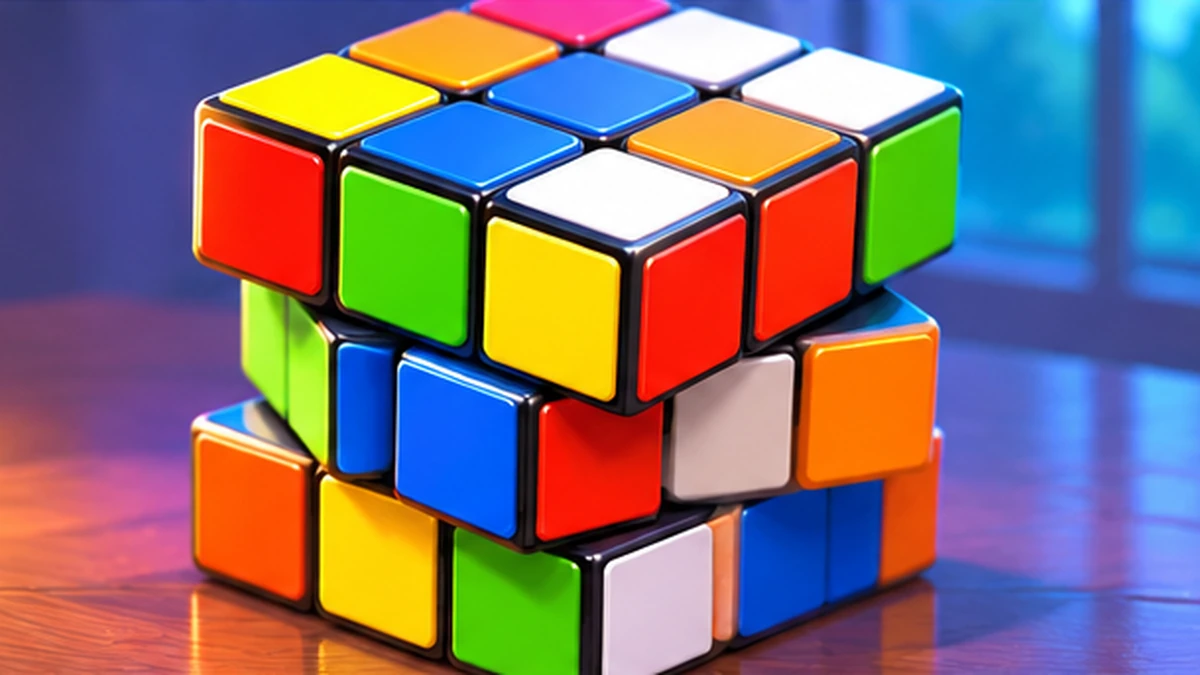
Cube 3D for Beginners: Turn the Right Layers and Match All Six Faces
Understand camera rotation, layer turns, centers, edges and corners in Cube 3D. Learn reversible moves and plan a standard 3×3 solve step by step.
Read article ↗
Turn the faces of a scrambled cube in Cube 3D and work toward a single colour on every side.
Play here in the browser.
 Cube 3D
Choose a small set of pieces to track before rotating. Random turns can disturb progress on a face you are not looking at, so inspect the neighbouring sides after a planned move.
Cube 3D is an interactive colour-cube puzzle. You manipulate the cube's layers to return the faces to a solved arrangement after a scramble. Unlike a flat matching board, each turn affects several visible or hidden facelets at once. Start by rotating the view enough to understand the object as a whole. A promising-looking front face does not tell you whether the neighbouring faces are also becoming organised.
The controls distinguish manipulating a layer from changing how you look at the cube. Make a short, deliberate drag and watch which part responds before attempting a longer sequence. If the view changes when you expected a face turn, take a moment to restore a useful angle. Keeping a consistent viewing position while practising makes consecutive turns easier to understand, because you can follow the same pieces rather than repeatedly losing their orientation.
The game includes cube-size and scramble-difficulty preferences, so check the selected puzzle before beginning a serious attempt. A smaller cube and a larger cube do not present the same number of pieces to track. Scrambling gives you a new starting arrangement; it is different from making progress toward the current solution. Choose the configuration you want first, then work on that arrangement without repeatedly replacing the problem whenever the faces become confusing.
A timer records the solving attempt, but understanding the effect of a turn is more useful than chasing speed immediately. Work with a small, intentional sequence and inspect what it changes on adjacent faces. Try to preserve the pieces you have already placed while considering the next part of the cube. If you follow a solving method you already know, maintain its viewing orientation carefully. If you are exploring without one, use each move as an observation about how layers carry pieces around the object. The puzzle rewards that spatial attention: a solution has to reconcile all the faces, not just produce a neat-looking side from one angle.
Yes. Cube-size preferences are included in this edition.
Viewing rotation changes your perspective; a layer turn changes the puzzle's arrangement.
No. Check the neighbouring and hidden faces as well; the full arrangement must be solved.
Set it before starting the arrangement you intend to solve, so you can work consistently on that puzzle.
Found a control that behaves differently? Tell us the game name and your device.
















Understand camera rotation, layer turns, centers, edges and corners in Cube 3D. Learn reversible moves and plan a standard 3×3 solve step by step.
Read article ↗
Improve Cross Runner with practical bridge alignment, hazard timing, landing checks and smarter coin and key collection routes.
Read article ↗
Learn the leaf traversal rules, plan flower-planting routes and use Undo to recover from awkward moves in Emoji Puzzle on RobixGame.
Read article ↗
Find exposed matches, clear rising rows and stay below the red line in Pet Merge on RobixGame. Includes a browser check, worked examples and a practi…
Read article ↗