How to Play Magic Block: Number Puzzle Rules and Strategies
An in-depth Magic Block guide with worked row and column sums, constrained-line strategies and practical mistakes to avoid.
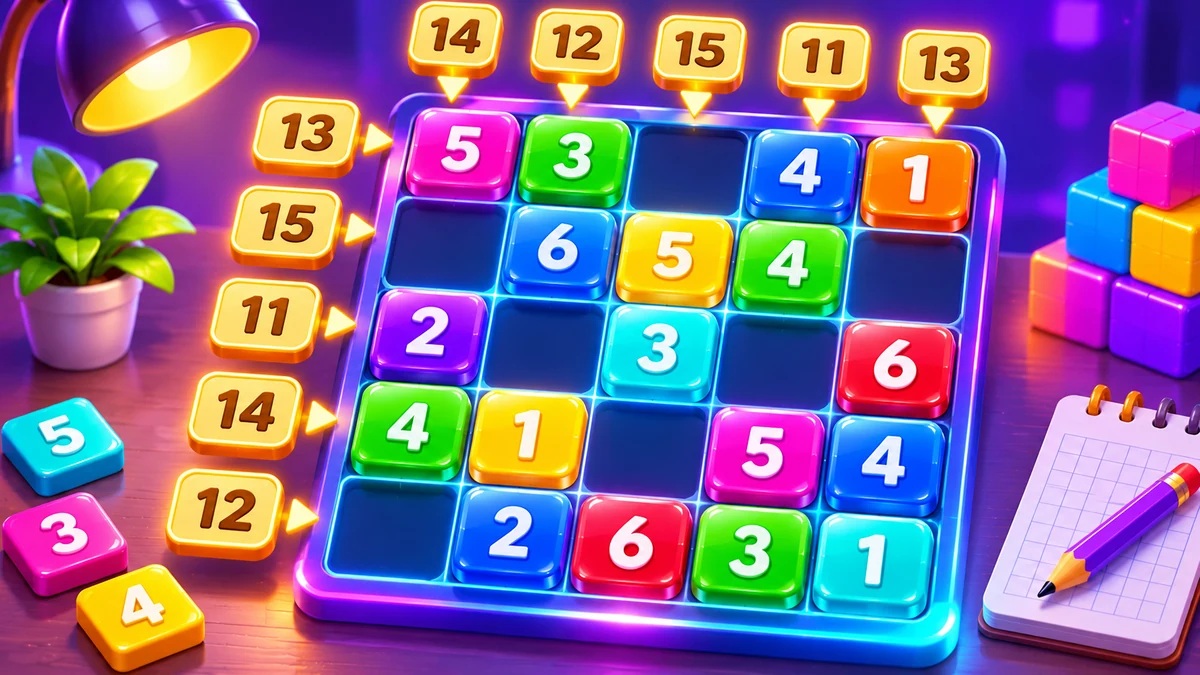
Table of Contents
- What Magic Block asks you to solve
- Start a new round without wasting your first move
- Subtract the known digits on an addition line
- Worked example: solving the crossing square
- Solve the most constrained line first
- A reliable two-direction checking habit
- What to do when several numbers look possible
- The most common beginner errors
- How to recover from a contradiction
- A short practice program for better number placement
- A deeper example: use a column to break a tie
- Using notes without making the puzzle tedious
- Playing comfortably on your device
- Frequently asked questions
- Is Magic Block like ordinary 2048?
- Should I finish rows or columns first?
- Why can a row look correct but the puzzle still be unsolved?
- What if I cannot determine the next tile?
- Can I play on a phone?
- Are there fixed solutions for every Magic Block board?
- Make your next move count
A number tile looks perfect for the row you are solving. It completes the target exactly, so placing it seems obvious. Then you check the column crossing that square and discover the same tile has left no room for the numbers still needed. That small surprise captures the central idea of Magic Block: every placement belongs to two calculations at once.
If you are wondering how to play magic block game online, start with a simple change in perspective. Do not treat the board as a set of separate horizontal sums. Think of it as one connected grid in which rows and columns share decisions. This guide explains the rules described on RobixGame, demonstrates an illustrative mini-puzzle, and offers a method you can use whenever the numbers become difficult to balance.
You can open Magic Block on RobixGame to follow the game instructions and practice alongside the guide. The examples here teach the underlying reasoning; they are not claimed to be screenshots or solutions to a specific live level.
What Magic Block asks you to solve
Magic Block is a number-placement puzzle with targets assigned to rows and columns. You work with numbered tiles and arrange their values so the required sums fit together. The important feature is the intersection: a tile contributes to the total of its horizontal row and its vertical column. Solving a row in isolation can therefore cause a contradiction somewhere else.
RobixGame’s edition uses a 3×3 grid and the digits 1 through 9 once each. Select a digit on the number pad, then select its cell. Choose 0 on the pad to clear a cell. Read the operators left to right in a row and top to bottom in a column, applying the first operation before the second.
A successful solving approach uses three ideas together: know how much each line needs, identify which lines have the fewest remaining choices, and check the effect of any number on the crossing line. These are general mathematical habits, not a secret shortcut that skips the puzzle.
Start a new round without wasting your first move
To play magic block game online free, open the RobixGame page, select Start Game, and inspect the targets before placing anything. First identify which numbers are already fixed, if any. Next note what tiles the game allows you to choose or move. Then look for rows or columns containing fewer open spaces than the others.
A helpful opening routine is to read the operators and find a line with few possible digit combinations. For a line that only uses addition, you can subtract known digits from the target. For a mixed-operation line, follow the printed order and test any candidate against the crossing target.
Only after you have checked the available values should you place a tile. You are not trying to move as quickly as possible; you are trying to avoid a chain of corrections. A few seconds of planning can save several trial-and-error moves.
Subtract the known digits on an addition line
The simplest way to understand how to solve magic block number puzzle is to subtract rather than guess. Suppose a row uses two plus signs and must total 15 and you already see 4 and 6 in that row. The remaining unfilled positions must together contribute 5, because 15 minus 4 minus 6 equals 5. This does not identify an individual square unless only one is empty, but it narrows the possibilities.
Now imagine the row has exactly one empty square. You can infer that its value must be 5. Before placing the 5, check its column. If that column also needs exactly 5 and permits the tile, the two constraints agree. If the column needs only 2, something earlier is inconsistent: either a prior placement must change or the assumed values are not compatible with the rules.
This method is stronger than visual guessing because every conclusion has a reason. It also tells you when to pause. If a required remainder is negative, or outside the values available in your version of the game, the current arrangement cannot satisfy that line as it stands.
Worked example: solving the crossing square
Consider a practice example using two addition rows. The first row shows 2 + □ + 4 = 11, so its middle digit must be 5. The second shows 3 + □ + 1 = 10, so its middle digit must be 6. Both central cells cross the same column.
If that column also uses addition and shows a 7 in its bottom cell with a target of 18, the inferred digits agree: 5 + 6 + 7 = 18. Each of the seven placed digits appears once. Guessing 8 for the second row instead would miss that row’s target and make the column total 20.
Use that reasoning when the crossing line has other operators too. Calculate its two operations in the printed order, then check that the candidate digits are available.
Solve the most constrained line first
A strong magic block number placement strategy begins where the choices are narrowest. Suppose one row has all three positions empty while another row has a single empty position. The one-cell row is often easier because its remaining value can be calculated directly. A column with just one empty square may provide the same advantage.
After filling one constrained square, revisit all lines crossing it. A row that previously had two unknown values may now have only one. This creates a chain of deductions: one certain value reveals the next certain value. It is a more controlled way to solve than choosing an attractive tile and building the puzzle around it.
Do not assume that “top row first” or “leftmost column first” is always a smart policy. Position on the screen is less important than the number of viable choices. If you can solve the third column confidently and the first row only by guessing, the third column deserves attention.
A reliable two-direction checking habit
Before every placement, ask: Does this number help satisfy the row? Does it also leave a possible solution for the column? The second question is easy to overlook when you are focused on a nearby target.
Suppose a row needs 8 across two open cells, and its crossing column needs 3 in the square you are considering. A 3 might be sensible, but you should check whether the second row cell can accept the remaining 5. If only 1 and 2 are available for that row, the proposed placement is not enough to complete the plan. You need to examine another cell or revisit an earlier assumption.
This is the essence of number grid puzzle solving strategies: avoid local progress that destroys global consistency. A move is good when it solves a small part of the board and keeps the unsolved parts possible.
What to do when several numbers look possible
Some positions cannot be calculated immediately. There may be two open squares in a row and several combinations that reach the target. Rather than guessing randomly, list the possibilities mentally or on paper. For a remainder of 7, the available pairs might be 2+5 or 3+4, depending on your tile set and whether duplicates are allowed.
Next use the crossing columns as filters. If the first square's column can only accept a 2 or 3, both pairs still remain. If the column requires exactly 3, you have a stronger clue. Continue checking constraints until one combination fits both directions. If two arrangements remain genuinely possible, work on another line and return later.
A pause is not a failure. In number puzzles, recognizing that you do not yet have enough information is often better than making an unsupported commitment.
The most common beginner errors
Players searching for a magic block puzzle for beginners often struggle with the same handful of mistakes. The first is completing a row without reading the column. The second is counting filled cells rather than adding their values. A third is overlooking how many spaces remain, which changes whether a sum is still possible.
Another common error is assuming that a line's target reveals the value of every square. A sum of 10 across three unknown cells does not identify a unique arrangement on its own. You need extra constraints from columns, available tiles, or the puzzle's rules.
Finally, avoid changing several placements at once after spotting a contradiction. If you replace three tiles, you may not know which correction helped. Reconsider the most recent uncertain choice, test one alternative, and check the affected lines before moving further.
How to recover from a contradiction
A contradiction is useful evidence. Suppose your row still needs 4, but the only space left in that row crosses a column that already reached its target. The current arrangement is inconsistent. Rather than forcing another number into place, trace backward to the last decision that was not fully justified.
Ask which tile was chosen by guesswork and which tiles were forced by arithmetic. Protect the forced placements if their assumptions remain valid, and revisit the guesses first. If the game allows rearrangement, make a single controlled change. Otherwise use its restart option and remember the conflict you discovered.
You can also compare the remaining targets with the remaining tiles. If the values left are all too large or too small for a required line, you have identified a capacity problem before taking another action. Such checks are practical magic block game tips and tricks because they explain why an attempt fails instead of offering a vague instruction to “think harder.”
A short practice program for better number placement
For your first practice session, concentrate only on reading the interface: row targets, column targets, available tiles, and whether a placement can be reversed. For the second session, solve the easiest one-empty line before making any uncertain move. On the third session, calculate the remainder of every line that contains a newly placed tile. On the fourth session, make a note of two situations in which your first guess would have broken a crossing target.
The goal is not to memorize a particular solution. It is to build a habit of questioning each move. Over several sessions, you should find it easier to recognize constrained lines, anticipate contradictions, and stop before a mistake spreads through the grid.
If you want to explore how to win magic block puzzle, think of winning as successfully satisfying the relationships shown by that particular board, not as applying one universal order of clicks. Every new arrangement may require a different sequence of deductions.
A deeper example: use a column to break a tie
Imagine a row with target 12 and two filled values, 2 and 3. Two spaces remain, so together they must contribute 7. The available choices include 1, 2, 3, 4, 5, and 6. You initially consider 1+6, 2+5, and 3+4. Each pair works for the row, but not every pair works elsewhere.
Suppose the first empty square lies in a column whose other values already total 9 against a target of 13. That square must be 4. You now know the second empty square must be 3, because the row needs 7 in total. The column has transformed an ambiguous row into a determined pair.
This is a good point to check whether 4 and 3 are actually available for placement in the puzzle you are playing. If the interface supplies tiles under additional restrictions, those rules still matter. The numerical argument alone is a candidate solution until it is compatible with the full board.
Using notes without making the puzzle tedious
You do not need a spreadsheet to play. A small table on paper with a row label and remaining sum is enough for difficult arrangements. For example, R1→5, R2→8, C1→4, C2→9 gives you a quick picture of where to focus. Refresh the note after each placement. If a value becomes zero, that line has reached its target; if it becomes negative, recheck the calculation and preceding moves.
For shorter sessions, do the same calculation mentally. The important thing is not the format of the note but the discipline of tracking what remains. If you find yourself losing track, slow down and verify each subtotal before continuing.
Playing comfortably on your device
Magic Block is available from its RobixGame page. A larger screen can make row and column labels easier to inspect, while fullscreen may provide more room. The game page includes Restart and Fullscreen controls. Device support and the exact selection gesture can depend on the running game, so follow the instructions actually displayed.
If a click or tap does not behave as expected, do not assume a hidden shortcut. Check whether the game has focus, verify the selected control method, and restart only if you are willing to lose the current attempt. Browser play usually avoids traditional installation but does require game resources to load, so offline support should not be assumed.
A clear, readable setup is more helpful to logic solving than a fancy display. Reduce unrelated distractions, use a screen size that shows the full grid, and take a short break if you begin repeating the same unproductive moves.
Frequently asked questions
Is Magic Block like ordinary 2048?
Not in the way this RobixGame page describes it. Magic Block is about placing numbers to satisfy row and column targets. A typical 2048 puzzle focuses on combining matching values. The strategy for one should not be blindly applied to the other.
Should I finish rows or columns first?
Neither direction always comes first. Start with whichever line has the fewest unknowns or the clearest deduction, then recheck the perpendicular lines after each move.
Why can a row look correct but the puzzle still be unsolved?
Because its placed tiles also contribute to columns. Every connected target must be compatible with the final arrangement.
What if I cannot determine the next tile?
Find a different line with fewer open spaces. List viable combinations for the uncertain line and use crossing targets to eliminate options. Avoid guessing until you have checked the alternatives.
Can I play on a phone?
RobixGame is accessible through browsers, but individual game input and device compatibility can vary. Check whether the game displays the complete grid and whether the necessary controls work on your device.
Are there fixed solutions for every Magic Block board?
Solutions depend on the board and the rule set. This article shows arithmetic techniques, not a claim that one specific click order solves every puzzle.
Make your next move count
The most satisfying Magic Block solution is one you can explain. You know why a number belongs in a square, how it affects the crossing line, and what possibilities remain afterward. That clarity turns an intimidating grid into a series of manageable deductions.
Start with the most constrained line, calculate what remains, test the crossing target, and be willing to postpone a move when the evidence is incomplete. Those habits will serve you better than speed or repeated guessing. Visit Magic Block on RobixGame to practice, or browse the RobixGame game collection for another thoughtful challenge.


