How to Play Ping Pong Ball: Aim into the Cup with Confidence
A Ping Pong Ball cup-aiming guide with trajectory basics, step-by-step shot corrections and common mistake explanations.
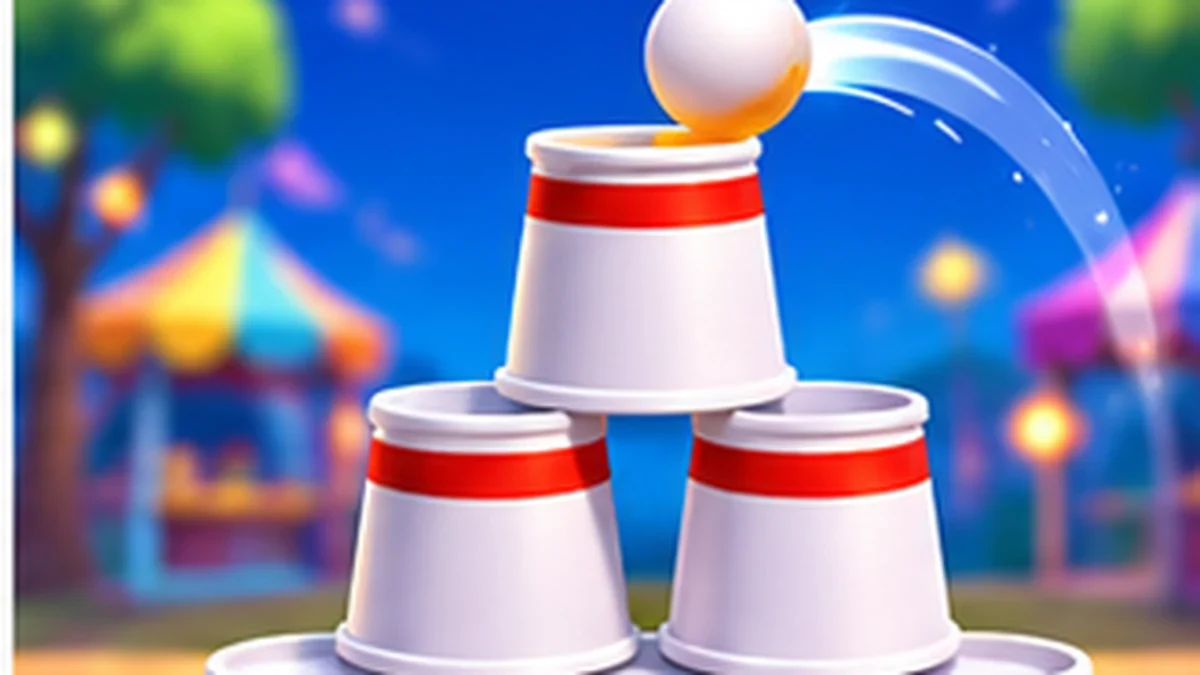
Table of Contents
- What is this particular Ping Pong Ball game?
- Your first shot: start with observation
- Four kinds of misses and what they mean
- Why the final part of the flight matters
- Worked example: fixing an overshoot
- Worked example: a ball that misses sideways
- Understanding the arc without getting lost in formulas
- Why aiming directly at the cup may fail
- Keep the setup repeatable
- How to use small corrections effectively
- A three-shot calibration drill
- What to do when nothing seems consistent
- Compare cup aiming with other ball games
- Playing without installing a game
- Frequently asked questions
- Is this a normal table tennis game?
- What should I change if the ball goes past the cup?
- What if the ball reaches the cup but hits the edge?
- Do I need to calculate exact angles?
- Can I play Ping Pong Ball online for free?
- Why do my shots keep changing even when I aim similarly?
- Turn a near miss into a better next attempt
The ball leaves its starting position, travels in a smooth arc, and passes just outside the rim of the cup. It was so close that you feel one small change should make the next attempt work. But what should you change? A little less force, a different direction, or a higher arc? The answer depends on how the ball missed, and learning to read that result is the satisfying part of Ping Pong Ball.
This guide explains how to play ping pong ball game online as featured on RobixGame. The specific game is a cup-aiming challenge, not a conventional table-tennis rally. You choose a direction, release a small ball, and adjust from where it passes the cup opening. The goal is to make better-informed attempts instead of launching randomly.
If you are searching for ping pong ball game online free, this guide focuses on the actual cup challenge available here rather than promising a table-tennis match.
Start from Ping Pong Ball on RobixGame, where the official page describes the cup objective and recommends comparing the last part of each shot. The examples below are illustrative: they explain useful aiming ideas without pretending to report precise game physics, hidden levels, or a guaranteed winning trajectory.
What is this particular Ping Pong Ball game?
The words “ping pong” can suggest a paddle, a table, and an opponent returning shots over a net. That is not the objective described for this RobixGame entry. Here the challenge is to get a small ball into a cup by adjusting its launch until the path meets the opening.
The ping pong ball cup game rules are built around observation and correction. Aim toward the cup, release the ball, and watch whether it lands, falls short, goes long, or passes to the side. The page's advice is to keep a repeatable starting setup and watch the final part of the flight, where tiny errors become easiest to understand.
If you arrive expecting a full table-tennis match, recognizing this distinction will save confusion. This is an aiming puzzle with a familiar ball, and its appeal comes from learning how each shot responds to your control.
Your first shot: start with observation
Open the game page and select Start Game. Locate the ball and cup. Notice their relative positions: is the cup level with the starting point, higher, lower, or offset sideways on the screen? Read the on-screen input instructions rather than assuming a particular drag gesture or keyboard key.
Choose a launch direction that seems to lead toward the cup. Release the ball and watch the entire motion. Do not immediately retry. First identify where it passed relative to the rim: before the cup, beyond it, or to one side. That observation gives you a specific reason for adjusting your next shot.
This is the most reliable way to begin how to get ball into cup game problems. Your first attempt need not succeed. Its job is to tell you how the current controls affect the ball.
Four kinds of misses and what they mean
A short shot falls before reaching the cup. If the game's control allows stronger or more suitable launch direction, a modest change may help. A long shot passes over or beyond the cup, suggesting that the launch is too aggressive for the current position. A sideways miss occurs when the ball's path is not centered on the opening. A rim contact occurs when the trajectory nearly works but the ball approaches at an unfavorable position or angle.
Do not apply the same correction to every error. If the ball travels too far but is perfectly centered horizontally, changing sideways aim may make things worse. If it passes the cup on the left while reaching the correct distance, reducing launch strength may not address the actual problem.
Good ping pong ball aiming tips begin by classifying the miss. Once you know what happened, adjust the variable that most plausibly caused it.
Why the final part of the flight matters
At the start of the shot, the ball may appear to travel toward the cup. That early direction is not enough to tell you whether the attempt will succeed. The important question is where the ball is when it reaches the height of the cup's opening.
A ball that travels directly above the cup may still overshoot if its forward movement is too strong. A ball that appears off-center during the first half of its arc might curve into a good position depending on the game's simplified physics. The most useful feedback comes close to the rim.
The RobixGame page specifically suggests observing where the ball passes the rim after a miss. That detail makes the game a useful exercise in patient visual correction: track the outcome where it counts, rather than reacting to an early impression.
Worked example: fixing an overshoot
Imagine that the cup is positioned a short distance to the right. On your first attempt, the ball travels in the right direction but passes well beyond the cup. The useful observation is that sideways alignment is roughly correct while distance is wrong. Try a small reduction in the launch or an adjustment to its upward angle, depending on which inputs the game offers.
On the second attempt, the ball still overshoots, but only slightly. That is progress: your correction moved the result closer to the goal. Avoid making a huge third adjustment. A small additional change may be enough.
If the next shot falls short, you have effectively bracketed the useful range between the second and third launch settings. Try something between them if the controls permit precise changes. This is a practical ball into cup game strategy because it converts near misses into directional clues.
Worked example: a ball that misses sideways
Now picture a cup directly ahead with a small offset to the left. Your shot reaches the appropriate distance but passes to the right of the opening. Instead of adjusting distance, focus on the launch direction. Move the aim slightly left while keeping other conditions as consistent as possible.
If your next attempt now misses on the left, you know the change went too far. Narrow the adjustment and try again. This is similar to finding a middle point between two alternatives; you do not need exact physics equations to use it.
Players searching for how to improve ball throwing accuracy can benefit from this approach. The most important principle is changing one variable at a time. If you alter both direction and launch intensity together, it becomes difficult to tell which adjustment helped.
Understanding the arc without getting lost in formulas
A launched ball travels through a curved path because its horizontal and vertical motion interact with gravity. A real ball's flight is more complex than a simple diagram: drag, bounce, collision shape, and the starting position can matter. Video games may simplify these factors significantly.
For this game, you do not need advanced mathematics. Think in terms of three practical questions: How high does the ball travel? How far does it move toward the cup? At what height does it cross the rim? A useful shot has to satisfy all three in the game engine's rules.
For a physics-minded player, a basic model of projectile motion explains why launch angle affects range and height. But do not assume an exact formula will match the game; it might use custom movement or collision behavior. Let repeated observation of the actual screen guide your adjustments.
Why aiming directly at the cup may fail
A common beginner mistake is pointing the launch exactly at the center of the visible cup. That might work in a game with straight-line movement, but a ball following an arc may need a different initial direction so it can descend into the opening. Depending on the launch point, the ball may have to travel upward before coming down.
Think about tossing a ball toward a wastebasket. A line from your hand to the center of the basket is not necessarily the path the ball will take; it rises and falls. In the game, the exact physics may differ, yet the visual idea remains useful.
The objective is not to create the prettiest arc. It is to find a trajectory that approaches the opening in a way the game's collision rules accept. That may require a moderate, controlled launch rather than maximum intensity.
Keep the setup repeatable
If the game places the ball and cup in a consistent starting arrangement, try to hold your input method steady while experimenting. Make a small change, compare it with the previous shot, and note the difference. If the positions change between attempts, re-evaluate the geometry rather than assuming the old settings still apply.
A simple mental record can help: “first shot went too far, second was almost correct, third dropped short.” This is enough to identify a useful adjustment direction without measuring angles or writing down numbers.
The official page's suggestion to keep a repeatable starting setup is especially valuable here. It helps you distinguish between a change caused by your input and a change caused by the game arrangement.
How to use small corrections effectively
Suppose the ball misses by only a little. A natural reaction is to make a dramatic adjustment to ensure it does not miss the same way twice. Unfortunately, that can turn a near success into an obvious failure. Instead, reduce the size of your changes as you approach a workable launch.
Begin with a rough estimate, then refine it. When the result moves closer to the cup, continue in that direction but with a smaller adjustment. When it moves farther away, reconsider whether you changed the right variable. If the controls offer only coarse inputs, make the best available comparison and avoid pretending you have precision the interface does not provide.
This is a core idea in cup toss game tips and tricks: experiment widely at first, then fine-tune. Large corrections are helpful when you are far off; small ones are more useful when a shot is almost landing.
A three-shot calibration drill
Try this exercise whenever a new cup arrangement appears. Shot one is a baseline: aim approximately at the opening, release, and classify the miss. Shot two changes only the most relevant factor. Shot three refines the direction that produced the better result. If the cup moves after each attempt, adapt the drill to the current position instead of expecting all three shots to share identical conditions.
This is not a promised three-shot solution. The point is to learn what each attempt tells you. A player who knows why a shot missed is in a better position than one who succeeded once by chance and cannot repeat it.
Over time, calibration builds an intuitive sense of the game's launch response. You may still miss, but your corrections will become more purposeful.
What to do when nothing seems consistent
If nearly identical inputs produce very different results, check whether the starting position changes, whether the cup has moved, or whether you are varying input duration without realizing it. Also check for any environmental or movement effects visible in the running game. Do not assume the physics are random until you have compared the conditions.
It may help to restart and use a simple, consistent approach to your first two shots. If the game uses a touchscreen, try keeping your gesture deliberate. If it relies on a mouse, ensure you are interacting within the intended play area. These are troubleshooting experiments, not guaranteed fixes for every device.
If a specific game repeatedly fails to register input, use RobixGame's support contact details with the game name and your device information. You do not need to share private data or account credentials to report a basic control issue.
Compare cup aiming with other ball games
The name Ping Pong Ball can attract people who want table tennis, ball physics puzzles, or arcade cup-toss experiences. These are different genres. Traditional table tennis involves rallies over a net and an opponent; this RobixGame title focuses on launching a ball into a cup.
When choosing a game, read its goal before making assumptions from the title alone. If you want a shooting challenge with a larger target, Basketball Dunk offers a different launch-and-aim idea. The ball, target, and movement will behave differently, but the habit of observing where a shot misses can transfer between them.
Searching for ping pong ball puzzle walkthrough should lead you toward learning the game mechanics, not an invented numbered-level list. Without verifying a specific level, the more reliable advice is to practice reading the final flight near the cup opening.
Playing without installing a game
You can play ping pong ball without downloading a traditional application by opening its RobixGame page in a compatible browser. The game still needs to load its resources, and internet access is commonly required. Do not assume it will function offline just because the page loaded earlier.
The page provides Start Game, Restart, and Fullscreen controls. Fullscreen can give you a larger view of the shot's path and rim. The specific aiming input may vary by device or browser, so follow the current game's instructions rather than guessing a keyboard shortcut.
For a comfortable session, try keeping the complete playfield visible. If the ball is difficult to track on a small screen, use a compatible device with a larger display when available. Take occasional breaks, particularly if repeated near misses become frustrating.
Frequently asked questions
Is this a normal table tennis game?
No. The RobixGame description says you aim a small ball into a cup, rather than exchange shots across a table-tennis net.
What should I change if the ball goes past the cup?
The game page suggests reducing or redirecting the launch slightly. Check whether the problem is distance, height, or sideways alignment before choosing a correction.
What if the ball reaches the cup but hits the edge?
Treat it as a near miss. Observe where the ball approaches the rim and try a small, targeted adjustment rather than starting over with an entirely different trajectory.
Do I need to calculate exact angles?
No. Repeated observation and gradual correction are usually more practical than relying on a formula that may not match the game's physics.
Can I play Ping Pong Ball online for free?
The game is offered on RobixGame as a browser-based title. Visit its page to play and check any current access requirements.
Why do my shots keep changing even when I aim similarly?
Check for small differences in your launch input, starting position, or current arrangement. The most useful comparison comes from keeping as many conditions constant as the game allows.
Turn a near miss into a better next attempt
The appeal of Ping Pong Ball is that it gives you immediate visual feedback. You can watch a ball almost enter the cup, decide what went wrong, and test a better idea. Progress comes from understanding the miss rather than blindly throwing again.
Start with a repeatable setup, observe the ball at the cup's height, and correct the most relevant factor one small step at a time. If the result improves, refine it; if it worsens, reconsider your direction. Open Ping Pong Ball on RobixGame to practice these ideas, or browse the RobixGame collection when you want a different kind of challenge.


